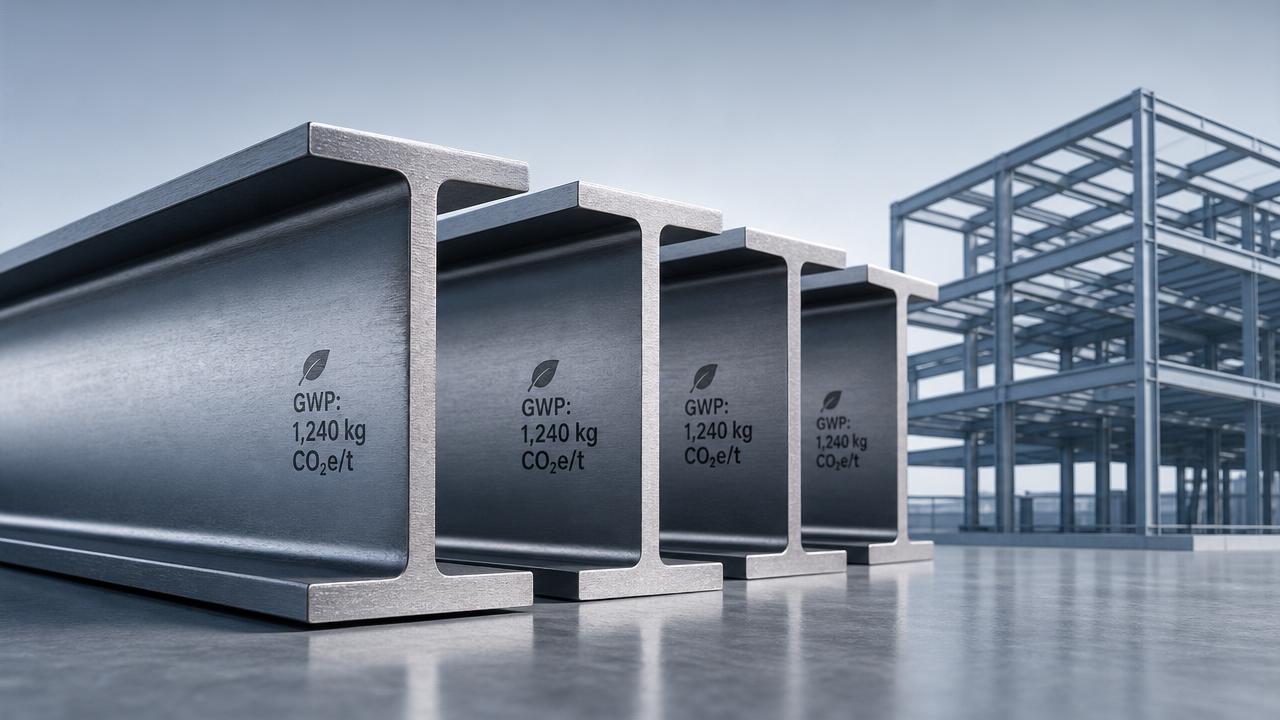
EU to Mandate Carbon Footprint Labels on Structural Steel from Jan 2027
The European Committee for Standardization (CEN) launched the draft revision of EN 1090-1:2026 on 12 May 2026, introducing a binding carbon footprint labeling requirement for structural steel products placed on the EU market. Effective 1 January 2027, all hot-rolled and cold-formed structural sections used in load-bearing construction — including H-, C-, Z-sections, I-beams, and angles — must carry certified Environmental Product Declarations (EPDs) and display their Global Warming Potential (GWP) in kg CO₂e per metric ton directly on product labels. This development significantly impacts global exporters, particularly manufacturers and traders in China supplying into EU construction supply chains.
Event Overview
The European Committee for Standardization (CEN) published prEN 1090-1:2026 on 12 May 2026. Clause 7.3.2 is newly added, requiring EPD certification and on-product GWP disclosure for structural steel sections intended for load-bearing building applications. Compliance becomes mandatory on 1 January 2027. Non-compliant products will be ineligible for CE marking — a legal prerequisite for placing such products on the EU market.
Industries Affected
Direct Exporters and Trading Firms
Export-oriented trading companies — especially those acting as CE-marking holders or authorized representatives for Chinese producers — face immediate regulatory exposure. Their ability to affix CE marking hinges on verified EPDs and label compliance. Failure to secure third-party LCA validation and update labeling workflows before Q4 2026 may result in shipment rejection at EU borders or loss of notified body approval.
Raw Material Procurement Entities
Procurement departments sourcing billets, slabs, or recycled scrap for structural steel production must now assess upstream environmental data traceability. Since EPD calculations require cradle-to-gate LCA inputs (including energy sources, alloy composition, and scrap origin), procurement contracts will need clauses mandating GWP-relevant data sharing from suppliers — a shift from traditional quality-and-quantity specifications.
Steel Fabricators and Rolling Mills
Manufacturers of hot-rolled and cold-formed structural sections must integrate life cycle assessment (LCA) modeling into their quality management systems. This includes selecting compatible LCA software, training technical staff, engaging accredited EPD program operators (e.g., EPD International or IBU), and validating assumptions around electricity mix, transport logistics, and coating processes. Label redesign and printing system upgrades also fall under operational scope.
Supply Chain Service Providers
Certification bodies, testing laboratories, and LCA consultants serving steel exporters will see rising demand for EPD verification, GWP benchmarking, and conformity documentation aligned with EN 15804+A2 and ISO 14040/44. However, capacity constraints are emerging: only ~17 EPD program operators globally are accepted under the EU’s ECO Platform, and fewer than five currently offer dedicated support for ferrous structural products in Asian manufacturing contexts.
Key Considerations and Recommended Actions
Initiate LCA Modeling by Q3 2026
Given typical LCA model development timelines (10–14 weeks) and third-party verification lead times (6–8 weeks), firms should begin data collection and scenario definition no later than July 2026 to meet the January 2027 deadline.
Validate EPD Program Operator Eligibility
Confirm that the chosen EPD program operator is listed on the EU ECO Platform and accepts declarations for structural steel categories under EN 1090-1. Not all operators cover hot-rolled sections or recognize regional grid emission factors applicable to Chinese production sites.
Update Technical Documentation and Label Templates
Revise Declaration of Performance (DoP), Factory Production Control (FPC) documents, and physical label layouts to include GWP values — ensuring alignment with both EN 1090-1:2026 Clause 7.3.2 and Regulation (EU) No 305/2011 (CPR).
Engage Notified Bodies Early on CE Marking Transition
Notified Bodies responsible for CE conformity assessment under EN 1090-1 must verify EPD integration into the manufacturer’s quality system. Proactive consultation — rather than last-minute submission — helps avoid delays in re-certification cycles.
Editorial Perspective / Industry Observation
Observably, this revision marks a strategic pivot from ‘compliance-by-document’ to ‘compliance-by-data’ in EU construction product regulation. While EN 1090-1 has long governed execution quality, the inclusion of quantified environmental performance embeds decarbonization directly into structural safety gateways. Analysis shows this is not merely an environmental add-on: it effectively establishes GWP as a functional property — like yield strength or weldability — subject to harmonized assessment and market surveillance. From an industry perspective, the tighter linkage between EPD validity and CE eligibility raises the barrier to entry for smaller mills lacking digital LCA infrastructure. It also incentivizes vertical integration among exporters who control both raw material sourcing and finishing operations — enabling more consistent data flows across the value chain.
Conclusion
This regulatory step signals that carbon transparency is becoming non-negotiable for structural materials entering regulated construction markets. Rather than representing a temporary policy experiment, the 2027 implementation reflects an institutionalized expectation: environmental performance must be verifiable, standardized, and visibly communicated at the point of use. For global suppliers, readiness hinges less on adopting new technologies and more on embedding environmental data governance into core production and compliance systems.
Source Attribution
Official draft: prEN 1090-1:2026, published by CEN on 12 May 2026 (reference: CEN/TC135/N3025). Final standard publication expected Q4 2026. Regulatory context: Regulation (EU) No 305/2011 (Construction Products Regulation) and Commission Delegated Regulation (EU) 2021/1676 (amending CPR Annex V). Note: The final text of EN 1090-1:2026, including any modifications to Clause 7.3.2 during formal voting, remains under observation until official publication.