NEWS
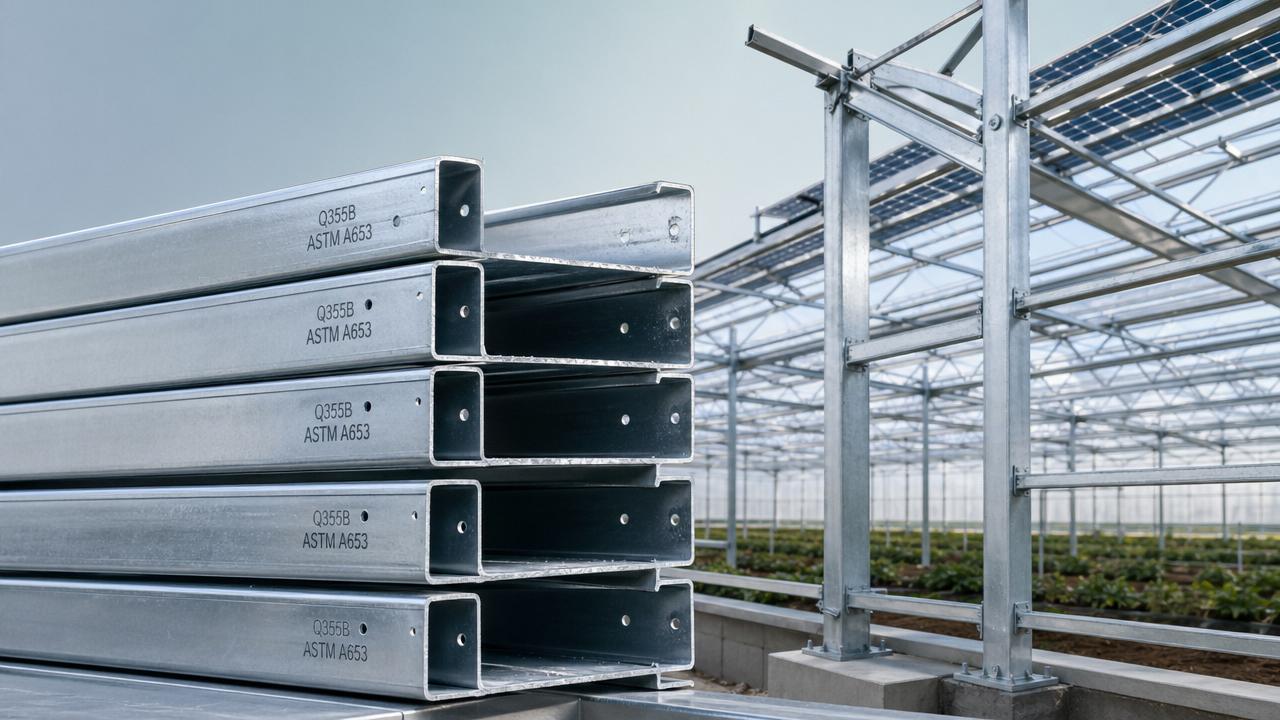
ASEAN statistics show a 42% year-on-year increase in galvanized C-section steel imports by Vietnam, the Philippines, and Indonesia in Q1 2026 — driven by accelerated construction of EV battery plants, agrivoltaic greenhouses, and flood-control steel structures. This development signals notable shifts for structural steel traders, fabricators, and supply chain service providers active in Southeast Asian infrastructure projects, particularly those sourcing from China’s southern and Bohai Rim production bases.
Event Overview
According to ASEAN Statistical Database data released on April 25, 2026, total galvanized C-section steel imports into Vietnam, the Philippines, and Indonesia rose 42% year-on-year in Q1 2026. The surge is attributed to concentrated project starts including new energy vehicle battery factory buildings, photovoltaic-agricultural大棚 (greenhouse) structures, and riverbank flood defense steel frameworks. In Vietnam, demand for Q355B-grade hot-dip galvanized C-sections is especially strong around Ho Chi Minh City, with delivery lead times compressed to under 12 days. Chinese manufacturers based in South China and the Bohai Rim region are responding via dual-port logistics through Tianjin Port and Qinzhou Port. Local compliance verification between ASTM A653/A792 standards and China’s GB/T 2518 remains a noted requirement.
Industries Affected
Direct Trading Enterprises
Export-oriented steel trading firms supplying galvanized C-sections to ASEAN markets face intensified order volume and tighter delivery expectations — especially for Q355B-grade material destined for Vietnamese infrastructure sites. Impact manifests in compressed quotation-to-shipment cycles, heightened documentation scrutiny (e.g., ASTM certification), and increased coordination needs with port agents in Tianjin and Qinzhou.
Raw Material Procurement Entities
Procurement teams at downstream fabricators or project integrators must reassess lead time assumptions for galvanized C-sections sourced from China. The 12-day delivery window reported in Ho Chi Minh City implies upstream inventory buffers may be insufficient; just-in-time procurement models risk disruption unless pre-verified ASTM-compliant stock is secured.
Steel Fabrication & Construction Firms
Fabricators engaged in ASEAN infrastructure projects — especially those executing EV plant or agrivoltaic structural packages — encounter accelerated sequencing of design, cutting, and galvanizing stages. The rapid import growth reflects real-time project execution pace, not merely tender activity; thus, fabrication capacity planning must now align with verified import lead times rather than historical averages.
Supply Chain & Logistics Service Providers
Third-party logistics operators managing cross-border steel shipments face elevated demand for documentation support (ASTM vs. GB/T compliance verification), port-specific handling protocols (Tianjin vs. Qinzhou), and expedited customs clearance tracking — particularly for shipments designated for flood-defense or industrial building applications where local regulatory review is prioritized.
Key Considerations and Recommended Actions
Monitor official standard alignment updates from ASEAN national standards bodies
While ASTM A653/A792 and GB/T 2518 share functional overlap, formal recognition status varies across Vietnam, the Philippines, and Indonesia. Stakeholders should track published technical circulars or import clearance advisories issued by each country’s Ministry of Industry or National Standards Authority — not rely solely on past acceptance patterns.
Prioritize verification of ASTM-compliant mill test reports for Q355B-grade shipments
Given the reported demand concentration around Q355B material in Vietnam, exporters and freight forwarders must ensure mill test reports explicitly reference ASTM A653 (for coated steel sheet) and/or ASTM A792 (for zinc-5% aluminum alloy-coated steel sheet), with traceable heat numbers and coating mass verification — not generic GB/T 2518 declarations.
Distinguish between procurement signals and actual project commissioning timelines
The 42% import increase reflects physical cargo movement in Q1 2026, not future tender announcements. Companies should treat this as evidence of active construction phase execution — not speculative demand — and adjust inventory, staffing, and subcontractor scheduling accordingly.
Pre-validate dual-port routing capacity with carriers and terminal operators
With reliance on both Tianjin Port and Qinzhou Port increasing, logistics planners should confirm current berth availability, inland transport connectivity (rail/road), and bonded warehouse access at both terminals — especially for shipments requiring post-arrival inspection or repackaging prior to ASEAN customs release.
Editorial Observation / Industry Insight
Observably, this import surge is less a preliminary market signal and more an operational confirmation: major infrastructure projects in Vietnam and the Philippines have moved beyond planning into tangible steel-intensive execution. Analysis shows the compression of delivery windows to under 12 days reflects site-level schedule pressure — not just procurement urgency. From an industry perspective, the data point underscores how regional energy transition and climate resilience investments are now directly shaping structural steel trade flows. It is not yet indicative of broad-based, long-term demand expansion across all ASEAN members, but rather a concentrated, project-driven inflection in specific geographies and applications.
Current monitoring should focus on whether Q2 2026 import volumes sustain the Q1 growth rate — particularly in Indonesia, where project visibility remains lower than in Vietnam or the Philippines — and whether ASTM compliance verification bottlenecks emerge at key ASEAN ports during peak shipment periods.
Conclusion
This 42% import increase is best understood not as a standalone trade statistic, but as a real-time indicator of accelerated physical construction activity tied to three high-priority infrastructure categories: EV industrialization, renewable energy integration, and climate adaptation. For stakeholders, the immediate implication is reduced margin for schedule slippage and heightened need for standards-aligned documentation — not a generalized uptick in regional steel demand.
Information Source
Main source: ASEAN Statistical Database (data release dated April 25, 2026). Note: Ongoing observation is recommended for Q2 2026 import figures and any subsequent technical circulars on ASTM/GB/T equivalency issued by Vietnam Standard and Quality Institute (STAMEQ), Philippine Bureau of Product Standards (BPS), or Indonesian National Standardization Agency (BSN).
Related Posts
- ▶ US CBP Tightens Steel Origin Verification for H-Beams & I-Beams
- ▶ Iran opens Strait of Hormuz for commercial vessels during ceasefire, risks remain
- ▶ Tata Steel Faces Closure of Coking Units in the Netherlands
- ▶ Nucor Raises Hot-Rolled Coil Prices Again by $10 per Ton in U.S.
- ▶ Global pig iron prices rose by $5–20 per ton in the first half of March
- ▶ Nucor Raises HRC Price to $1,010/Ton - 8th Weekly Increase
- ▶ Tata Steel UK raises hot-rolled coil prices by £125/t
- ▶ Global Steel Production Drops 6.5% in January 2026
- ▶ EU Parliament Seeks Ban on Russian Steel Imports
- ▶ Nucor raises prices for hot-rolled coil in the US for the second week in a row
Online Message


Leave A Message
If you are interested in our products and want to know more details, please leave a message here, we will reply you as soon as we can.